What is SEObot AI
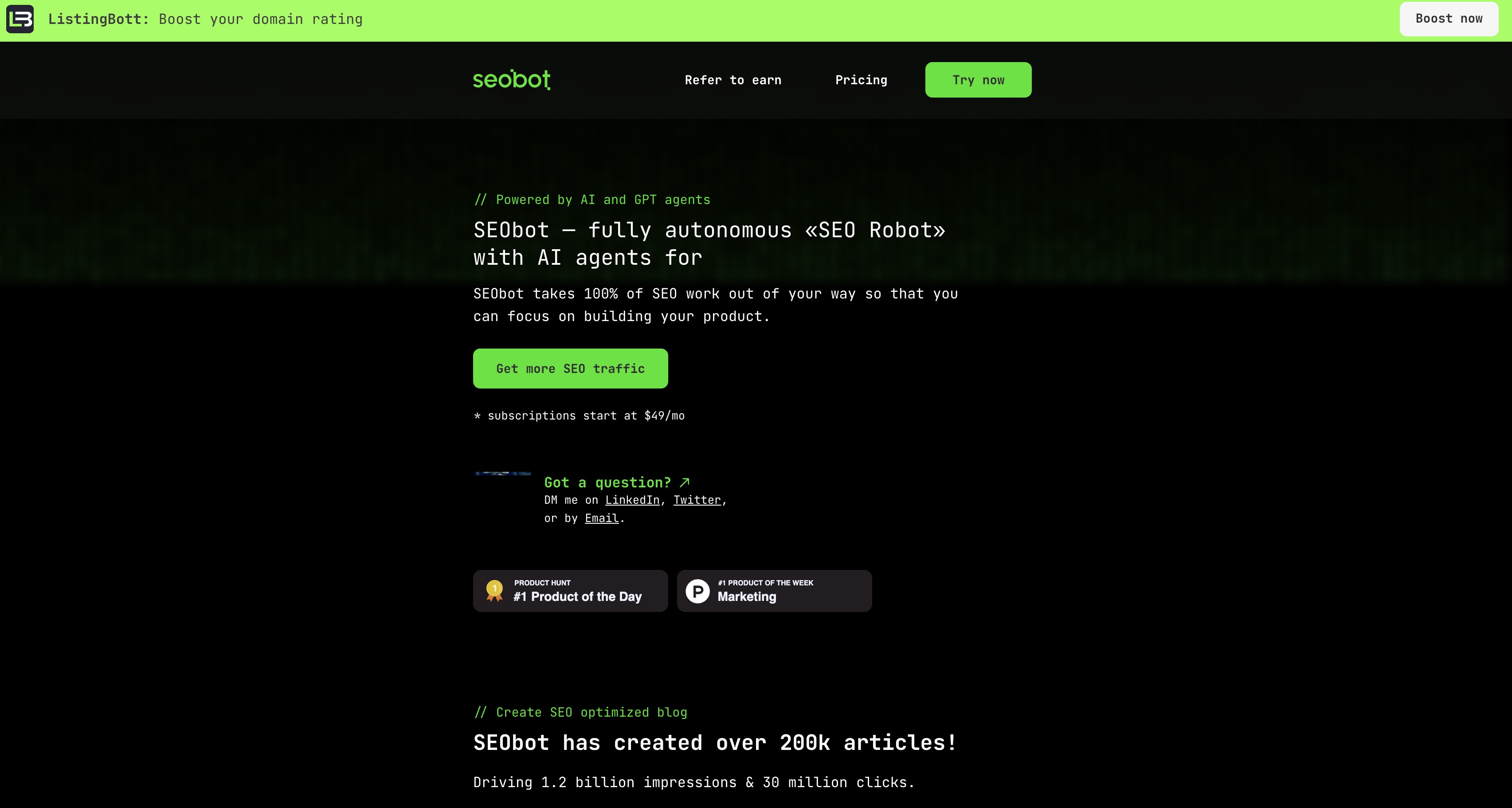
SEObot AI is a fully autonomous “SEO Robot” built for busy founders who want to grow organic traffic without managing day‑to‑day SEO tasks. It combines multiple SEO AI agents to research your site and audience, build a content strategy, write high‑quality long‑form articles, handle internal linking, and sync everything directly to your blog or CMS. Designed as an all‑in‑one SEO AI agent, SEObot has already created over 200,000 articles, generating more than a billion impressions and tens of millions of clicks for SaaS products, blogs, and directories.
How to use SEObot AI
Sign up and connect your website
Go to the SEObot AI app and create an account. During onboarding, provide your website URL so SEObot can start analyzing your domain, structure, and existing content.Choose your CMS and integrations
Select the CMS or platform you use for your blog, such as WordPress, Webflow, Ghost, Shopify, Framer, Notion, HubSpot, Next.js, Unicorn Platform, Wix, or others. Connect via native integrations, REST API, or webhooks so SEObot can publish and sync content automatically.Let SEObot research your audience and keywords
SEObot scans your website, niche, and competitors to understand your audience, topics, and ranking opportunities. It uses Google scraping and research to build a data‑driven understanding of what you should write about.Generate a content plan on autopilot
After the research phase, SEObot creates a content plan for your blog. This plan typically includes listicles, how‑to guides, checklists, versus articles, technical deep dives, news pieces, and even YouTube‑based articles tailored to your industry and goals.Review, approve, or adjust upcoming articles
Inside the SEObot dashboard, you can see scheduled articles before they are published. You can approve or decline drafts, edit them directly, or provide additional instructions and ideas if you want more control over tone and topics.Publish SEO‑optimized articles via your CMS
Once approved, SEObot automatically pushes articles to your CMS. Each piece can include up to around 3,000–4,000 words, images, internal and external links, embedded YouTube videos, tables, and structured formatting optimized for search.Enable internal linking automation
Turn on internal linking automation so SEObot can scan your content and automatically add smart internal links between blog posts and key pages. As your content library grows, SEObot continuously updates and improves your internal link graph.Use advanced modules: programmatic SEO, news, and tools
Activate additional modules such as programmatic SEO, news article generation, and interactive SEO mini‑tools. SEObot can build data‑driven templates, generate news stories, and create SEO tools like calculators and analyzers that attract organic traffic.Convert YouTube videos into SEO articles
For video content, provide a YouTube URL and let SEObot transform it into a comprehensive, search‑optimized article. This repurposes your video content into written format to reach search audiences.Monitor performance and iterate
Track clicks, impressions, and traffic growth from SEObot‑generated content. Use these insights to refine your content strategy, adjust your publishing frequency, and scale successful formats across more topics and languages.
SEObot AI's use case
Founders who have no time for SEO
Ideal for solo founders and small teams who want to grow organic traffic but can’t manage keyword research, writing, and optimization manually. SEObot handles the full SEO workflow while you focus on product and customers.SaaS and digital product companies
Great for SaaS tools, platforms, and digital services that need consistent educational content, comparison pieces, and how‑to guides to capture intent‑driven search traffic and convert readers into users or demo requests.Content‑driven blogs and niche directories
Useful for blogs, resource hubs, and directories that want to scale content output. SEObot can generate hundreds or thousands of articles across different categories while maintaining internal linking and topical structure.Technical and developer‑focused sites
Suitable for technical blogs and frameworks (e.g., Next.js projects) that require structured guides, FAQs, and deep‑dive tutorials. SEObot can create long‑form technical content and keep it internally linked within your documentation or blog.Programmatic SEO and template‑based content
Perfect for sites that rely on programmatic SEO, such as comparison pages, location pages, or large sets of similar templates. SEObot builds data‑based templates, fills them with relevant information, and publishes them at scale.Brands targeting multiple languages
Helpful for global companies that want to publish SEO content in many languages. SEObot supports 50+ languages, allowing you to localize content and capture search demand in multiple markets.News and trend‑driven publishers
Valuable for blogs that cover industry news and updates. SEObot’s news module can identify suitable stories, generate news articles, and publish them quickly, helping you stay relevant around updates like algorithm changes.Sites that use interactive SEO tools for traffic
Ideal for marketers who want to attract visitors via free tools such as keyword difficulty checkers, schema generators, or calculators. SEObot can design and generate these interactive mini‑tools to create additional entry points for organic traffic.
Benefits of SEObot AI
End‑to‑end SEO automation
SEObot removes most manual SEO work by automating research, content planning, article writing, internal linking, and publishing. This allows you to maintain a consistent content pipeline without building a large content team.High‑output, long‑form content creation
The platform is optimized for long‑form articles averaging around 3,000–4,000 words, including images, tables, lists, and YouTube embeds. This type of in‑depth content tends to perform well in search results and capture long‑tail queries.Built‑in research, fact checking, and anti‑hallucination
SEObot uses Google scraping and research, along with a fact‑checking and anti‑hallucination reflection system, to reduce errors and improve reliability. Each article goes through multiple AI agents and tasks to increase accuracy and trustworthiness.Intelligent internal and external linking
The tool automatically identifies anchor text opportunities and creates internal links to your most important pages, while also adding relevant external references. This improves crawlability, topical authority, and user navigation with minimal manual work.Programmatic SEO and news capabilities
With dedicated modules for programmatic SEO and news content, SEObot helps you scale beyond standard blog posts. You can generate large sets of templated pages and time‑sensitive news articles that capture emerging search demand.Interactive SEO tools that drive organic traffic
SEObot can produce interactive SEO mini‑tools such as analyzers, generators, and calculators tailored to your niche. These tools provide immediate value to visitors and act as powerful magnets for organic traffic and backlinks.Deep CMS and integration support
Native integrations with popular platforms (WordPress, Webflow, Ghost, Shopify, Framer, Notion, HubSpot, Unicorn Platform, Wix, Next.js, and more) make it easy to plug SEObot into your existing stack. REST API and webhooks support further customization and automation.Multi‑language support for global growth
Support for over 50 languages lets you deploy SEO content strategies across multiple regions and languages, helping you reach international audiences without hiring multiple language‑specific teams.Flexible human oversight and editing
While SEObot runs on autopilot by default, you can review, edit, and moderate every article. This balance of automation and control allows you to maintain brand voice and quality standards while still benefiting from AI‑driven scale.Scalable results for traffic and leads
By combining automation, volume, and SEO best practices, SEObot helps you grow impressions, clicks, and conversions over time. Case studies on existing domains show consistent traffic growth and the ability to generate meaningful leads and customers from search.